Why Annual Pentests Are Failing Your Team (And What to Do About It)

AI can now generate working exploits in hours. If your last security test was last quarter, your applications have been effectively unvalidated for months. The answer is not more manual pentests. It is testing that moves at the speed of your releases.
There is a number that should change how every AppSec leader thinks about their testing calendar: less than one day.
That is the current mean time from vulnerability disclosure to confirmed exploitation in 2026, according to the Zero Day Clock — down from 2.3 years as recently as 2019. In less than a decade, the window between a vulnerability being known and being weaponized has collapsed almost entirely.
And yet most security programs are still operating on a quarterly or annual testing cadence. That mismatch is not a gap. It is a chasm.
The Threat Environment Has Changed. Testing Schedules Have Not.
The 2026 CrowdStrike Global Threat Report documents what many security leaders are starting to feel but have not yet fully operationalized: AI has permanently accelerated the adversary. The average eCrime breakout time in 2025 fell to 29 minutes. The fastest observed intrusion moved from initial access to data exfiltration in four minutes.
This is not a trend. It is a structural shift.
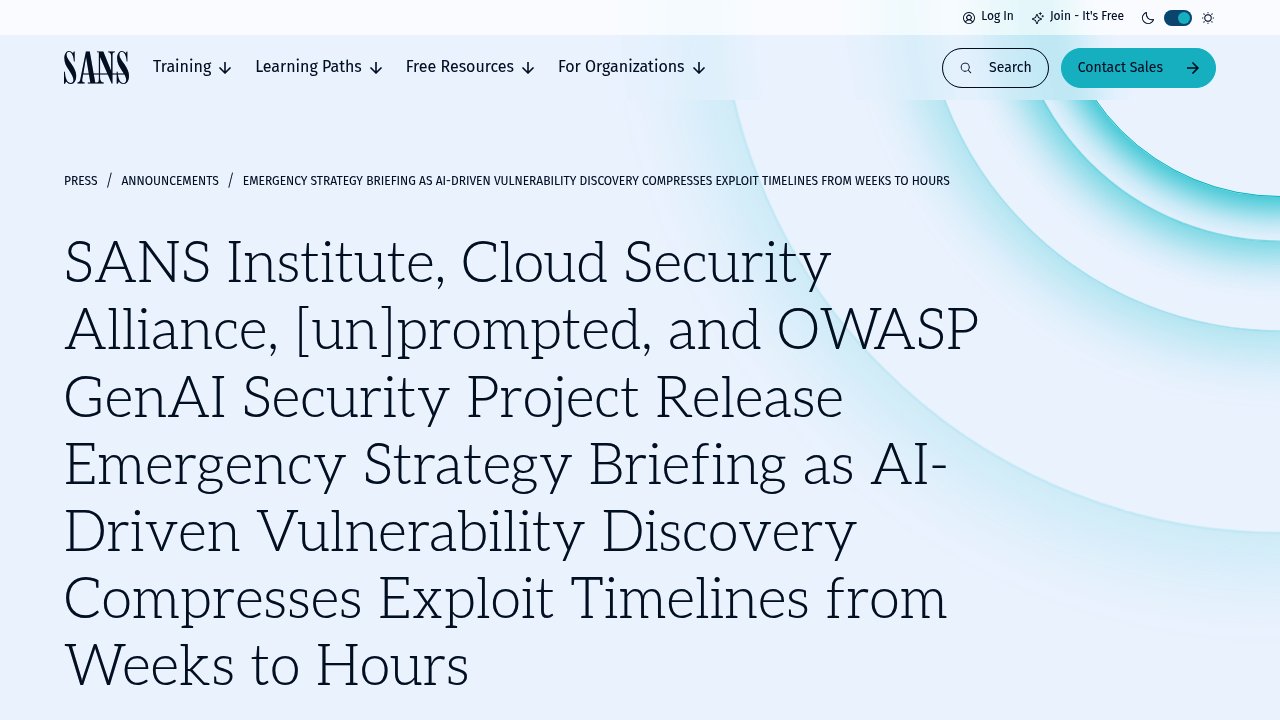
In April 2026, SANS Institute and the Cloud Security Alliance released an emergency strategy briefing titled "The AI Vulnerability Storm," responding directly to AI models that can autonomously identify thousands of zero-day vulnerabilities across major operating systems and browsers. One model generated 181 working exploits against Firefox vulnerabilities in internal testing. Another autonomous system reached administrator-level access in eight minutes.
The practical implication for AppSec teams: the time between a vulnerability being introduced into your codebase and a capable attacker finding and exploiting it is now measured in hours, not months.
If your last security review was 90 days ago, you have been running blind for 90 days.
What "50% of organizations fail to test after each release" actually means
The coverage post on this blog noted that 50% of organizations fail to test the security of their applications after each release. That statistic was alarming before AI-accelerated exploitation became the norm. Now it is a critical risk disclosure.
Consider what it means in practice:
- A development team ships a release every two weeks
- Security testing runs quarterly
- At any given moment, six releases are in production with no security validation
- Each of those releases could contain logic flaws, new API endpoints, or changed authentication flows that attackers can probe with AI-assisted tools
The exposure window is not the time between your last test and today. It is the time between your last test and the next one, multiplied across every unvalidated release in production.
Why Testing Cadence Hasn't Kept Up
The honest answer is not that security teams are complacent. It is that the tools and workflows that define most AppSec programs were not designed for the current environment.
Traditional penetration testing is slow by design. Scoping, scheduling, execution, and reporting for a single application can take weeks. For organizations with hundreds of applications, that creates an impossible queue. Prioritization decisions get made, and most of the portfolio ends up waiting.
The result is a structural mismatch between two timelines that are moving in opposite directions:
- Dimension: Development release cadence — Direction of Travel: Getting faster (weekly or daily for many teams)
- Dimension: Attacker exploitation speed — Direction of Travel: Getting faster (hours to days with AI tooling)
- Dimension: Security testing cadence — Direction of Travel: Largely unchanged (quarterly to annual)
Something has to give. And right now, it is the security coverage that gives.
There is also a subtler problem: even when organizations do test more frequently, they often do it with the same manual-first workflows that created the bottleneck in the first place. More scheduled pentests does not equal faster coverage. It equals a longer queue.
What the Right Frequency Actually Looks Like
The right testing frequency is not a number on a calendar. It is alignment with your release cadence.
If your team ships software every two weeks, security validation should happen every two weeks. If a critical application deploys to production on a Tuesday, it should be validated by Wednesday. The metric that matters is not "how many tests did we run this quarter" but "how many days after each release was this application validated?"
That reframing changes the conversation entirely. It shifts security from a periodic audit function to an operational one, integrated with how engineering actually works.
Release-aligned validation in practice
Staris is built around this model. Rather than scheduling point-in-time pentests, Staris runs continuous, release-aligned security validation that proves which vulnerabilities are actually exploitable in running applications. Most customers execute a validation for each release cycle, producing verified findings with proof-of-exploit rather than a queue of scanner alerts to triage.
The operational difference is significant:
- Testing cycles drop from weeks to hours. In one evaluated deployment, a testing cycle that previously required 130+ hours completed in approximately 24 hours, while identifying more vulnerabilities including novel logic flaws.
- Zero false positives. Every finding comes with exploitation proof, so engineering teams act immediately rather than spending cycles on triage.
- Coverage scales without headcount. Staris runs simultaneously across multiple applications, eliminating the queue that makes frequent testing operationally impossible with manual methods.
The goal is not continuous scanning in the sense of running a scanner on a loop. The goal is continuous validation at the pace your team ships software. Those are meaningfully different things.
The Question Worth Asking Your Team This Week
The SANS Institute briefing published in April 2026 offered a specific first action for security leaders: point AI agents at your own code this week. The reasoning is direct. If offensive AI tools can find and exploit vulnerabilities faster than your current testing cadence can detect them, the only defensible response is to close that gap.
For most AppSec programs, closing the gap does not require more budget for more pentests. It requires a different operating model, one where security validation is release-aligned, automated, and fast enough to keep pace with both engineering and the adversary.
The question to ask: For each application in production right now, how many days has it been since the last validated security review? If the answer is measured in months, the exposure window is open.
Staris helps Product Security teams answer that question with a number they can act on, and then systematically drive it toward zero. If your team is ready to move from point-in-time pentesting to release-aligned validation, request a demo to see how it works in practice.


